ECON 132 ยท Public Economics
Chapter 3 ยท Stiglitz / Rosengard

Market Efficiency

Why are competitive markets efficient under ideal conditions? The two fundamental theorems of welfare economics, Pareto efficiency, and the three efficiency conditions.

In most modern industrial economies, the private market produces and distributes goods. One of the oldest claims in economics is that this form of organization leads to an efficient allocation of resources. But if that is true โ€” why do we need a government at all?

1 ยท Adam Smith's Invisible Hand

In the Wealth of Nations (1776), Adam Smith coined the famous metaphor:

"He intends only his own gain, and he is in this, as in many other cases, led by an invisible hand to promote an end which was no part of his intention. Nor is it always the worse for the society that it was no part of it. By pursuing his own interest he frequently promotes that of the society more effectually than when he really intends to promote it."

The intuition: when firms chase higher profits, they produce the goods consumers are willing to pay for. When consumers buy as cheaply as possible, orders flow to the most efficient producers. The market coordinates without any central planner.

2 ยท Pareto Efficiency

Modern economists sharpen Smith's idea with the concept of Pareto efficiency:

Definition ยท Pareto Efficiency An allocation is Pareto efficient if no one can be made better off without making someone else worse off. A Pareto improvement makes at least one person better off without making anyone worse off.

Pareto efficiency is a weak standard โ€” it says nothing about distribution. A world in which one person owns everything and everyone else starves can be Pareto efficient (any redistribution would make the rich person worse off). And the other way around: an allocation in which no one can be made better off without making others worse off can still be highly unequal.

Two properties:

  • Individualistic: the concept accepts people's preferences as they are โ€” no paternalistic claim about what the "right" preferences should be.
  • Consumer sovereignty: each person is the best judge of their own well-being.

3 ยท The Two Fundamental Theorems of Welfare Economics

The two most important results in welfare economics:

First Theorem Every competitive market equilibrium is Pareto efficient. Under ideal conditions (perfect competition, complete markets, complete information, no externalities), the free market produces an allocation from which no Pareto improvement is possible.
Second Theorem Every Pareto-efficient allocation can be reached as a competitive market equilibrium โ€” given a suitable initial redistribution of resources. In other words: if society wants a particular distribution, it can achieve it by redistributing the initial endowments and then letting the market work.

The theorems have a strong policy implication: efficiency and distribution are analytically separable. The government can focus on redistributing initial endowments and then use the market for allocation โ€” without manipulating prices.

Important Caveat Both theorems only hold under very strict assumptions. As soon as there is market failure (monopolies, public goods, externalities, asymmetric information), the theorems no longer apply. This is the bridge to the rest of public economics: chapters 4โ€“7 study exactly these failure cases.

4 ยท Efficiency from the Perspective of a Single Market

In the standard supply-and-demand model:

  • The demand curve shows the marginal benefit of an additional unit to consumers.
  • The supply curve shows the marginal cost of an additional unit to producers.
  • In market equilibrium: marginal benefit = marginal cost.
Market demand and supply
Figure 3.1 The market demand curve is built by horizontally summing individual demand curves. In equilibrium, the marginal consumer's extra willingness to pay equals the marginal cost of production โ€” the core of the efficiency idea.

If MB > MC, more should be produced (a Pareto improvement is possible). If MB < MC, too much is being produced โ€” cutting back improves welfare. Only when MB = MC is the allocation efficient. That is exactly what the competitive market delivers.

5 ยท From a Single Market to General Equilibrium

In general equilibrium there are four markets:

  • Product market โ€” e.g. apples, oranges.
  • Factor market โ€” e.g. labor, capital.
  • Market linkages โ€” the output of one market is an input to another.
  • Future markets โ€” saving links today's and tomorrow's consumption decisions.

In general equilibrium, Pareto efficiency requires three conditions โ€” exchange, production, and product mix.

6 ยท Exchange Efficiency

Given a fixed total output: how should the goods be distributed across consumers? The answer:

Exchange Efficiency Condition The marginal rate of substitution (MRS) between any two goods must be the same for all consumers.

MRSAX,Y = MRSBX,Y for all consumers A, B and all pairs of goods (X, Y).

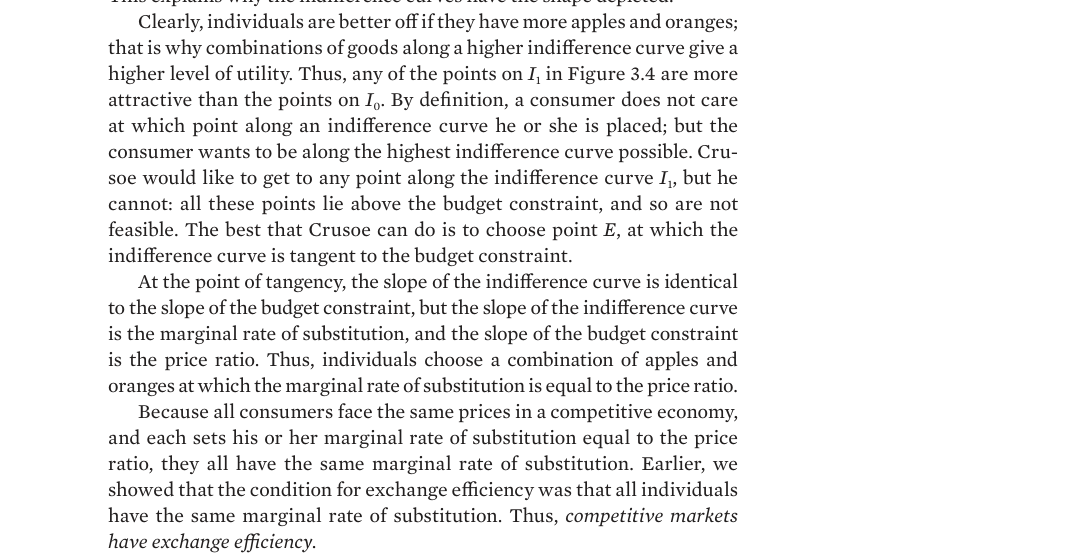
Intuition: if consumer A is willing to give up 2 oranges for 1 apple, while B is willing to give up 3 oranges, there is a trade that makes both of them better off. As long as the MRS values differ, the allocation is not Pareto efficient.
Edgeworth Box
Figure 3.5 ยท Edgeworth Box The Edgeworth box shows every possible allocation between two consumers. The Pareto-efficient points are those where the indifference curves are tangent (equal MRS). The line through all these tangencies is called the contract curve.

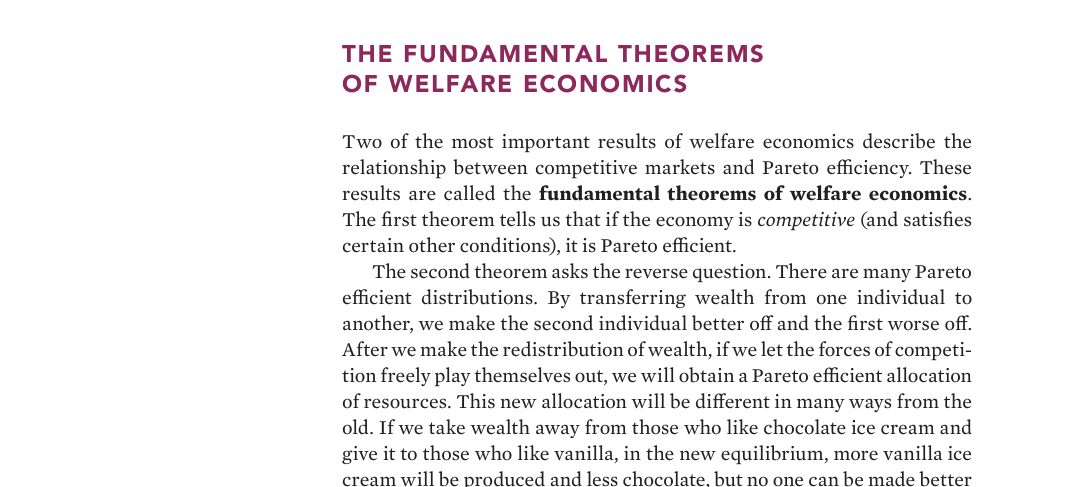
Indifference curves are the tool: they show the combinations of goods between which a consumer is indifferent (same utility level). The slope of an indifference curve is exactly the MRS.
Budget Constraint
Figure 3.4 Consumer choice: the budget constraint (slope = relative prices) is tangent to the highest reachable indifference curve. At the optimum, MRS = price ratio. Because all consumers face the same market prices, their MRS values automatically line up โ€” the competitive market satisfies exchange efficiency.

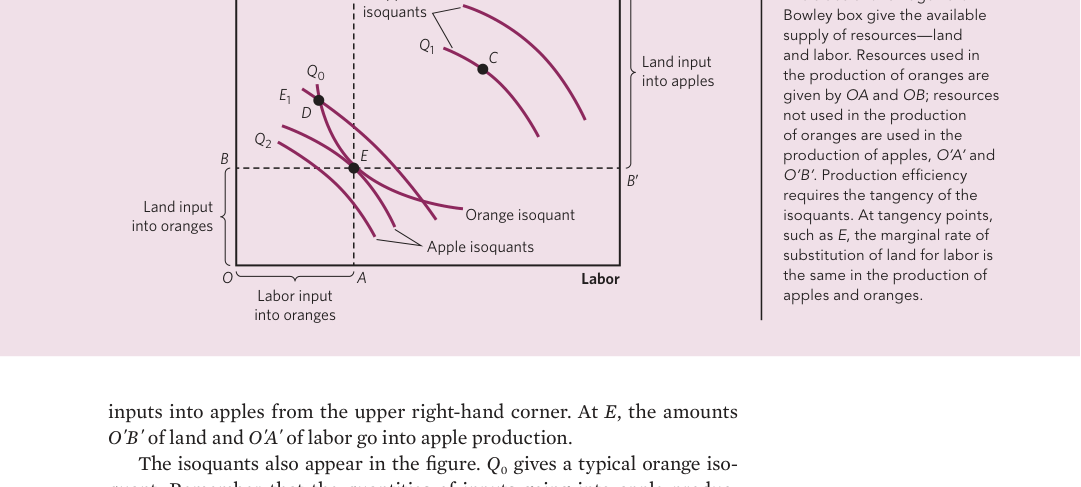
7 ยท Production Efficiency (Input Efficiency)

Given the total amount of inputs being used: are they distributed efficiently across producers?

Production Efficiency Condition The marginal rate of technical substitution (MRTS) between any two inputs must be the same for all producers.

MRTSFirm1 = MRTSFirm2 for all firms and all input pairs.

Tool: isoquants โ€” the combinations of inputs that produce the same level of output. Slope = MRTS.
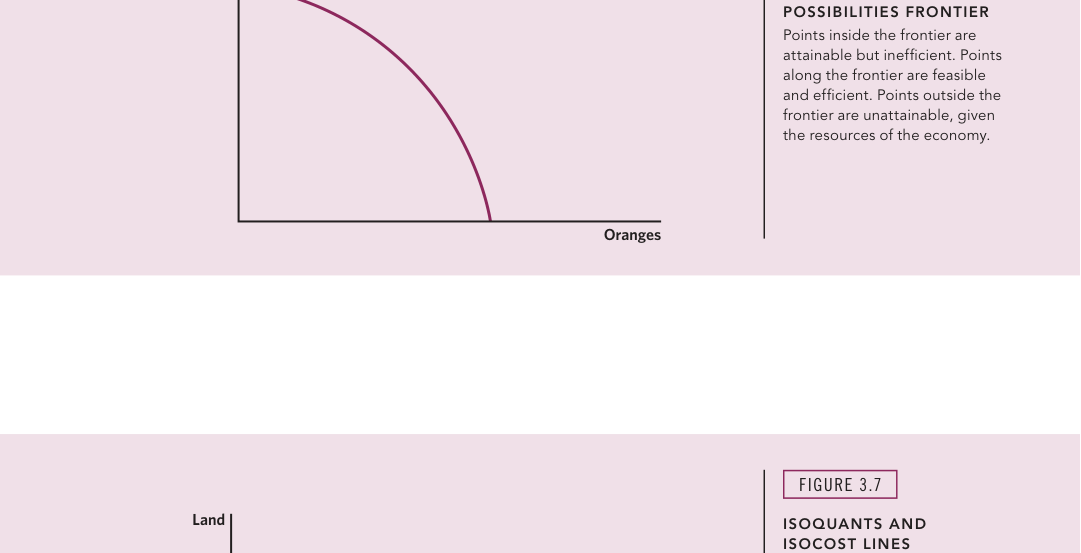
Isoquants and Isocost
Figure 3.7 Isoquants (same level of output) and the isocost line (same input cost). Optimal production is the tangency point. Here MRTS = input price ratio. Because all firms face the same factor prices, their MRTS values line up โ€” the competitive market satisfies production efficiency.

8 ยท Product Mix Efficiency (Substitution Efficiency)

Which mix of goods should be produced? This question ties supply and demand together.

Product Mix Efficiency Condition The marginal rate of transformation (MRT) between any two goods must equal the MRS of all consumers.

MRTX,Y = MRSX,Y

Intuition: the MRT tells you how much Y the economy could technically produce if it gave up one unit of X. The MRS tells you how much Y consumers are willing to give up for one unit of X. When the two diverge, a Pareto improvement is available.
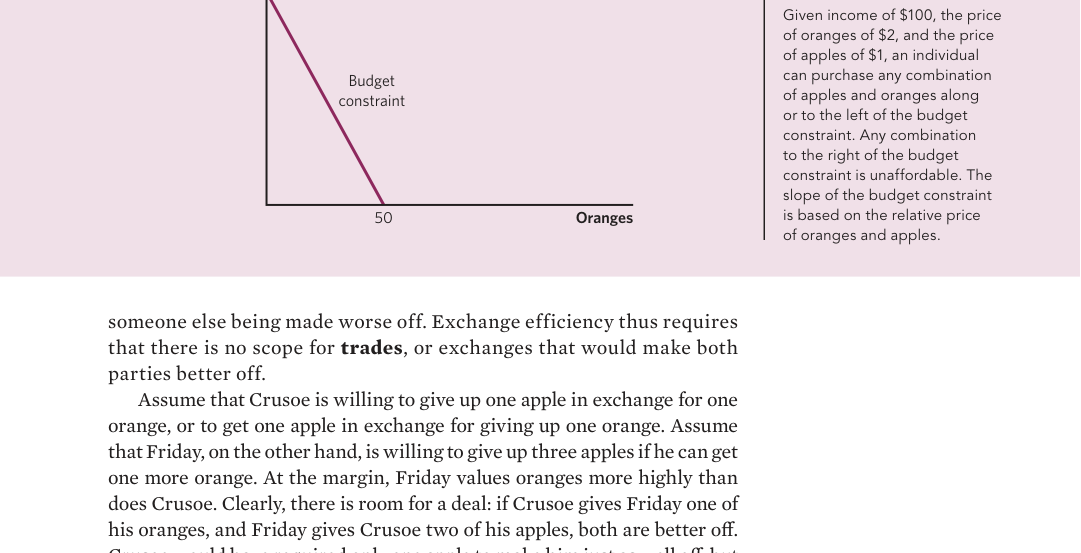
Production Possibilities Frontier
Figure 3.8 ยท Production Possibilities Frontier The PPF shows the maximum feasible combination of two goods given the economy's resources. Slope = MRT. At a Pareto-efficient equilibrium: a common tangency point between the PPF and the highest reachable indifference curve. Since MRT = PX/PY and MRS = PX/PY, we get MRT = MRS in any competitive market.

9 ยท Utility Possibilities Frontier

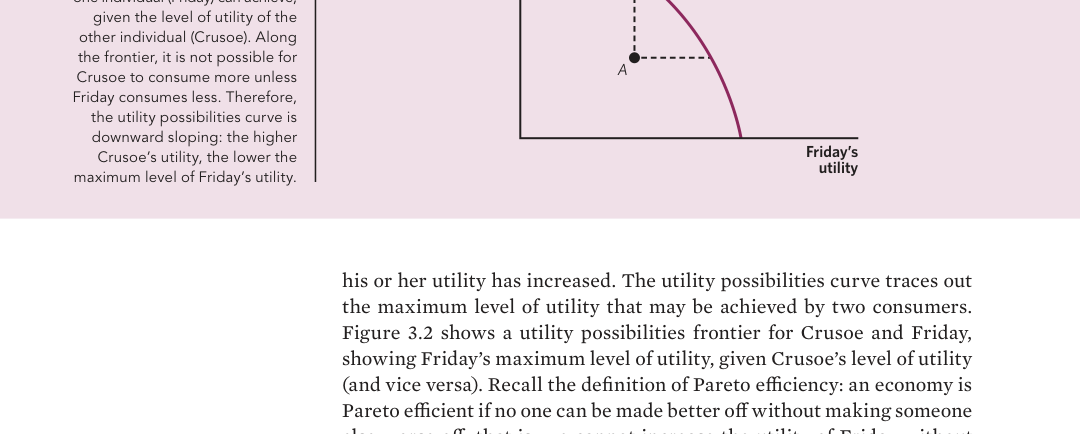
An alternative way to picture Pareto efficiency: the utility possibilities curve. For two consumers (Crusoe and Friday), it shows the maximum reachable combinations of utility.
Utility Possibilities Curve
Figure 3.3 ยท Utility Possibilities Curve Every point on the curve is a Pareto-efficient allocation. Points inside the curve are inefficient โ€” a Pareto improvement is available. Points outside are technically unreachable. The curve slopes downward: more utility for Crusoe can only come at the cost of less utility for Friday.
Chapter Take-away Under ideal conditions, the competitive market produces a Pareto-efficient outcome โ€” a remarkable property that Smith already sensed in 1776 and that is formalized today as the First Theorem of welfare economics. Three conditions must hold: equal MRS across all consumers (exchange efficiency), equal MRTS across all firms (production efficiency), and MRT = MRS (product mix efficiency). The market achieves all three automatically because every actor faces the same prices. The catch: all of this only holds when there is no market failure. Chapters 4โ€“7 show that in the real world this is often not the case.

Flashcards โ€” Chapter 3

Click a card to flip it. Use the arrow keys to navigate.

Term
Click to flip
Definition
Click again to flip back

Quiz โ€” Chapter 3

13 multiple-choice questions.

Problem Set โ€” Chapter 3

Seven open-ended exam-style questions. Click a question to reveal the model answer.

1 Define Pareto efficiency and Pareto improvement. Why is an allocation in which one person owns everything Pareto efficient?

Definitions

Pareto efficient: an allocation in which no one can be made better off without making someone else worse off.

Pareto improvement: a move from one allocation to another that makes at least one person better off and no one worse off.

Why an extreme distribution can be Pareto efficient

If one person owns everything and everyone else starves, any redistribution makes the owner worse off. So no Pareto improvement is possible โ€” and therefore the allocation is Pareto efficient. This shows how weak Pareto efficiency is as a standard: it says nothing about distribution or fairness.

That is exactly why the Second Theorem matters: if society wants a different distribution, it can redistribute the initial endowments and then let the market work โ€” without manipulating prices. Efficiency and fairness are analytically separable.

2 Explain the three conditions for Pareto efficiency in general equilibrium. Which variable is being equalized in each? Why does the competitive market satisfy them automatically?

1. Exchange Efficiency

The MRS of every consumer is the same for any pair of goods. A trade that makes both parties better off is impossible exactly when MRSA = MRSB.

Why competition delivers this automatically: each consumer maximizes utility โ†’ MRS = PX/PY. Since they all face the same prices, they all have the same MRS.

2. Production (Input) Efficiency

The MRTS of every producer is the same for any pair of inputs. Shifting inputs between firms can no longer raise one firm's output without lowering another's.

Why competition delivers this automatically: each firm minimizes cost โ†’ MRTS = w/r. Since they all face the same factor prices, they all have the same MRTS.

3. Product Mix (Substitution) Efficiency

MRT = MRS. The economy produces goods in the proportion that consumers value most.

Why competition delivers this automatically: firms produce until P = MC. So MRT = MCX/MCY = PX/PY = MRS.

The market achieves all three conditions because every actor sees the same prices โ€” that common "language" guarantees that the marginal rates line up.

3 What do the two fundamental theorems of welfare economics say? What is the policy implication of the Second Theorem?

First Theorem

Every competitive market equilibrium is Pareto efficient โ€” under ideal conditions (perfect competition, complete markets, complete information, no externalities).

Second Theorem

Every Pareto-efficient allocation can be reached as a competitive market equilibrium โ€” given a suitable initial redistribution of resources.

Policy Implication

Efficiency and distribution are analytically separable. If society wants a particular distribution, the theoretically most efficient way is:

  1. Use lump-sum transfers to redistribute the initial endowments.
  2. Let the market handle the allocation โ€” no price controls.

The practical catch: real lump-sum transfers (paid to everyone, independent of behavior) are very hard to implement. Real taxes depend on income and behavior and therefore create distortions โ€” so in practice there is a trade-off between efficiency and distribution. But the theoretical point stands: competition and redistribution are not opposites.

4 A student says: "If the market is Pareto efficient, there is no reason for the government to act." Criticize this claim in 4โ€“5 sentences.

The claim has three problems:

1. Pareto efficiency only holds under very narrow assumptions (perfect competition, complete information, no externalities). In the real world these almost never all hold โ€” monopolies, public goods, externalities, and asymmetric information are everywhere.

2. Pareto efficiency is a weak standard. An allocation in which one person owns everything can be efficient โ€” but hardly fair. Even when the market is efficient, the government can still act for distributional reasons.

3. Pareto efficiency is about static allocation. It says nothing about stability (recessions), growth, or dynamic efficiency โ€” areas where government action can also make sense.

Stiglitz's point: even the strongest defense of the market still leaves three legitimate jobs for the government โ€” correcting market failures (Ch. 4), redistribution (Ch. 7), and stabilization (Ch. 9).

5 What is the Edgeworth box? What does the contract curve show? Explain using the example of two consumers with apples and oranges.

Edgeworth Box

A two-dimensional diagram that shows every possible way to split a fixed amount of goods between two consumers. The box has two axes for each consumer (one per good); consumer A measures from the bottom-left corner, B from the top-right. Every point in the box is a complete allocation.

Example

Total of 10 apples and 10 oranges. The box is 10ร—10. The point (3, 7) means: A has 3 apples and 7 oranges; B has 7 apples and 3 oranges. Both sets of indifference curves are drawn in (A's curves from the bottom left, B's from the top right).

Contract Curve

The line through all tangency points between the two sets of indifference curves. At every point on the contract curve: MRSA = MRSB โ†’ Pareto efficient. Points off the curve are inefficient โ€” trade could make both parties better off.

Implication

If the initial endowment is off the contract curve, there is a series of trades that lead to a point on the curve. Which point on the curve is reached depends on bargaining power. In market equilibrium, it is the intersection of the relative price line with the curve.

6 What does the Utility Possibilities Frontier (UPF) show? Compare points that are (a) on the UPF, (b) inside it, and (c) outside it.

UPF

The UPF shows, for two consumers, the maximum reachable combinations of utility given the economy's resources. It is the Pareto frontier in utility space.

Points on the UPF

Pareto efficient. Making one person better off requires making the other worse off. In goods space, the UPF corresponds to the contract curve.

Points inside the UPF

Pareto inefficient. At least one person can be made better off without making the other worse off. Many real economies sit here โ€” market failures, waste, and friction pull them inward.

Points outside the UPF

Technically unreachable with current resources. Such points could only be reached through growth, innovation, or additional resources (shifting the UPF outward).

What the UPF does not say

Which point on the UPF is "best" โ€” that is a question for the social welfare function (a value judgment!). Pareto efficiency alone does not pick between the points on the UPF.

7 In a hypothetical market, the marginal cost of one unit of X is $4 and one unit of Y costs $6. Consumer A is willing to give up 2 Y for 1 X. Consumer B is willing to give up 1.5 Y for 1 X. Which conditions of Pareto efficiency are violated? How can the allocation be improved?

Summary of the data

  • MRSA = 2 (A would give up 2Y for 1X)
  • MRSB = 1.5 (B would give up 1.5Y for 1X)
  • MRT = MCX/MCY = 4/6 = 0.67

Exchange Efficiency is violated

MRSA (2) โ‰  MRSB (1.5). A Pareto improvement is possible through trade: B gives A one unit of X in exchange for, say, 1.75 Y. A gets X for less than 2 Y (gain), B gets more than 1.5 Y for the X (gain). Keep trading until the MRS values line up.

Product Mix Efficiency is violated

MRT (0.67) โ‰  MRS (both A and B have MRS > MRT). Consumers value X more highly than its production cost relative to Y. Fix: produce more X. As long as MRS > MRT, the economy gains by shifting production toward X.

Final state

After adjustment: MRSA = MRSB = MRT. Where exactly this lands depends on the scale and curvature of the curves. Concretely: producing more X lowers PX (with elastic demand), and the MRS falls for both consumers โ€” until a new equilibrium is reached in which all three rates line up.