The state provides a wide variety of goods, from national defense to education. What are the economic properties of these goods? How do they differ from ice cream or clothing? And how much should be produced?
1 · The Two Basic Questions
To distinguish public goods from private goods, economists ask two questions:
- Is consumption rival? If one person uses the good, can another no longer use it? Example: an apple = rival. Lighthouse light = non-rival.
- Is exclusion possible? Can people who do not pay be excluded from consuming the good? Example: movie tickets = excludable. National defense = non-excludable.
2 · Classification of Goods
The two questions together generate a 2×2 scheme:
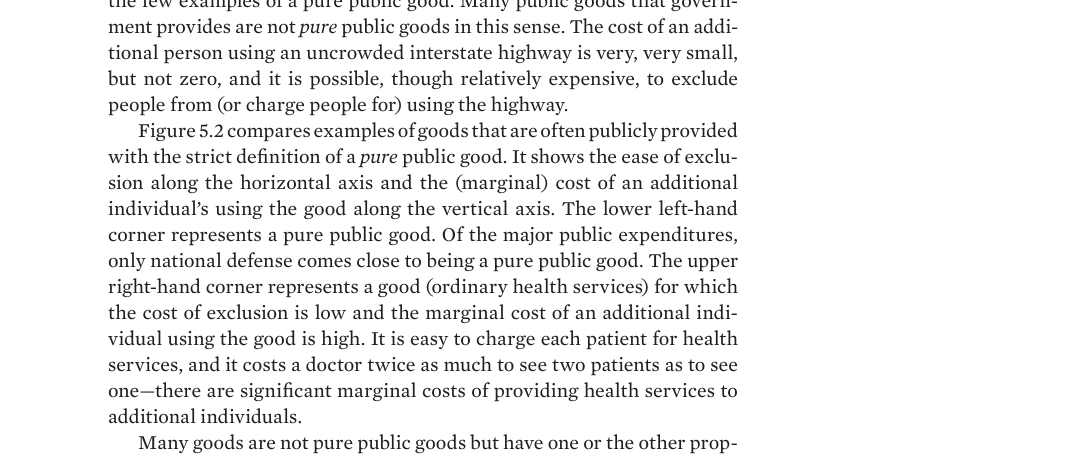
- Pure public good (non-rival + non-excludable): national defense, basic research, lighthouse light.
- Pure private good (rival + excludable): apples, clothing, ice cream.
- Club good (non-rival + excludable): cable television, toll roads at low utilization, private country clubs.
- Common-pool resource (rival + non-excludable): fish stocks in the ocean, common pasture land, free roads in congestion.
3 · Non-Rival but Excludable: Club Goods and User Fees
Example: a bridge with a toll booth. As long as the bridge is operated below its capacity, an additional car costs nothing — consumption is non-rival. But the toll booth makes exclusion possible.
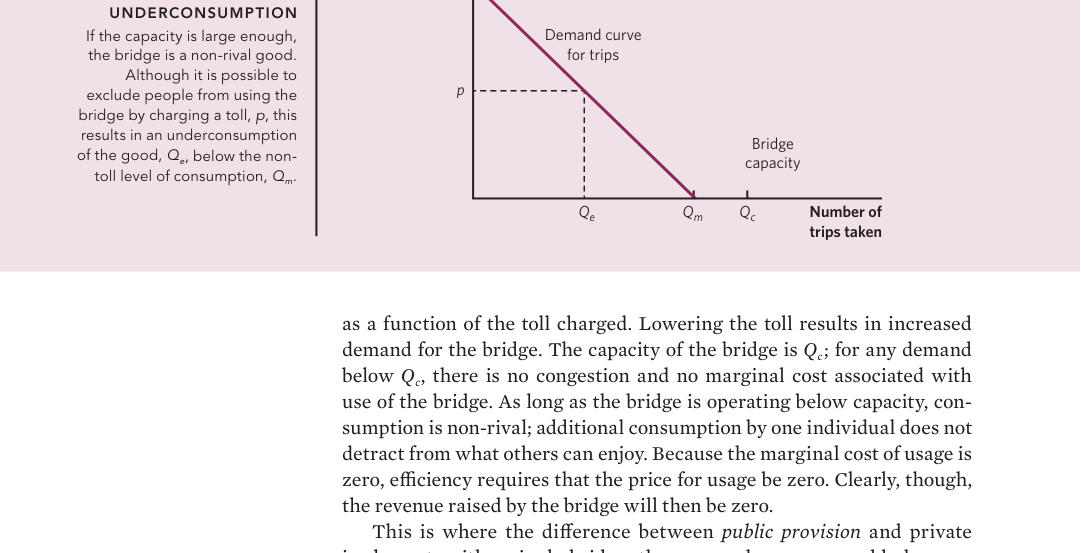
When deciding on toll structures, governments weigh equity (fair distribution) against efficiency (correct incentives).
4 · Non-Excludable: Free Riders and Private Provision
When exclusion is not possible (national defense, clean air), the market either does not produce the good at all or produces too little of it. Free Rider Problem: if everyone hopes that others will pay, no one pays.
Rare exceptions exist where a single large consumer benefits so much that they finance the good alone (example: beekeeping for one's own honey production automatically provides pollination for neighbors). But the rule is: non-excludable goods need the state.
5 · Publicly Provided Private Goods
Here comes something surprising: some goods that are technically private goods (rival, excludable) are nevertheless provided publicly. Examples:
- Education in public schools (rival in class size).
- Water from the municipal network (rival).
- Police protection (partially rival).
Why public provision? Three reasons:
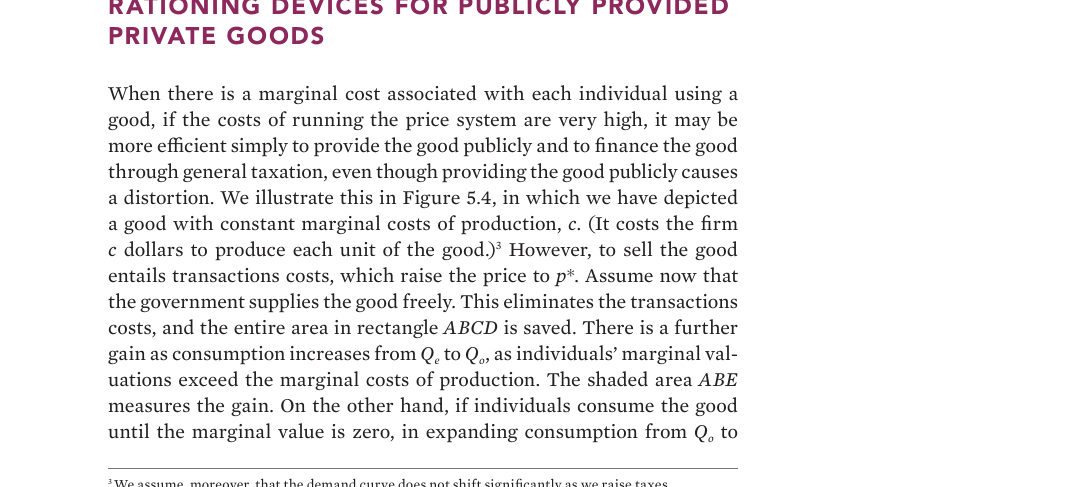
- Transaction costs: charging a toll on every road is more expensive than free provision financed through taxes.
- Externalities: education has positive externalities — the market would provide too little.
- Distributional goals: some goods (health, education) should be available regardless of income.
6 · Three Rationing Methods
For publicly provided private goods a problem arises: if the good is not sold at a market price, how do we distribute it?
1 · User Fees
Advantage: those who benefit pay. Reduces overconsumption.
Disadvantage: underconsumption for non-rival goods; administrative costs.
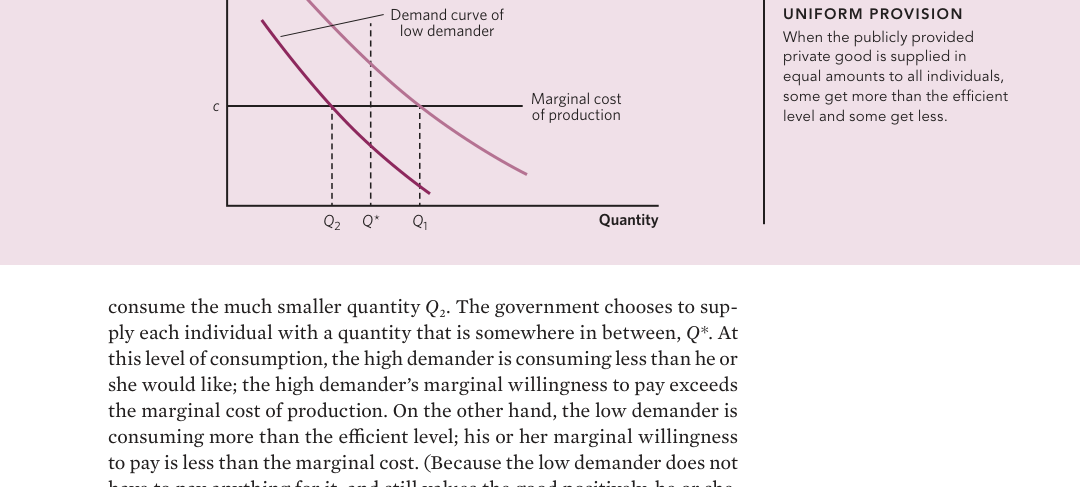
2 · Uniform Provision (same amount for all)
Advantage: saves transaction costs (no price system needed).
Disadvantage: leads some to underconsumption, others to overconsumption. High-demand consumers often buy additional amounts on the private market (private schools alongside public ones).
3 · Queueing
Advantage: self-selection — those most willing to wait get the good. Possibly fairer than price rationing.
Disadvantage: time is inefficiently burned. An hour in line is just as "lost" as an hour of work. Example: waiting lists for organ transplants, hospital admissions in some countries.
| Method | Advantage | Disadvantage |
|---|---|---|
| User Fee | Those who benefit pay | Underconsumption; admin costs |
| Uniform Provision | Saves transaction costs | Under-/overconsumption, two-tier market |
| Queueing | Self-selection: those truly in need | Time is wasted |
7 · How much public good should be produced?
For private goods: the market finds the efficient quantity (P = MC). For public goods individuals do not buy directly. Allocation happens through collective decisions (elections, administrative decisions, court rulings).
8 · Individual Demand for Public Goods
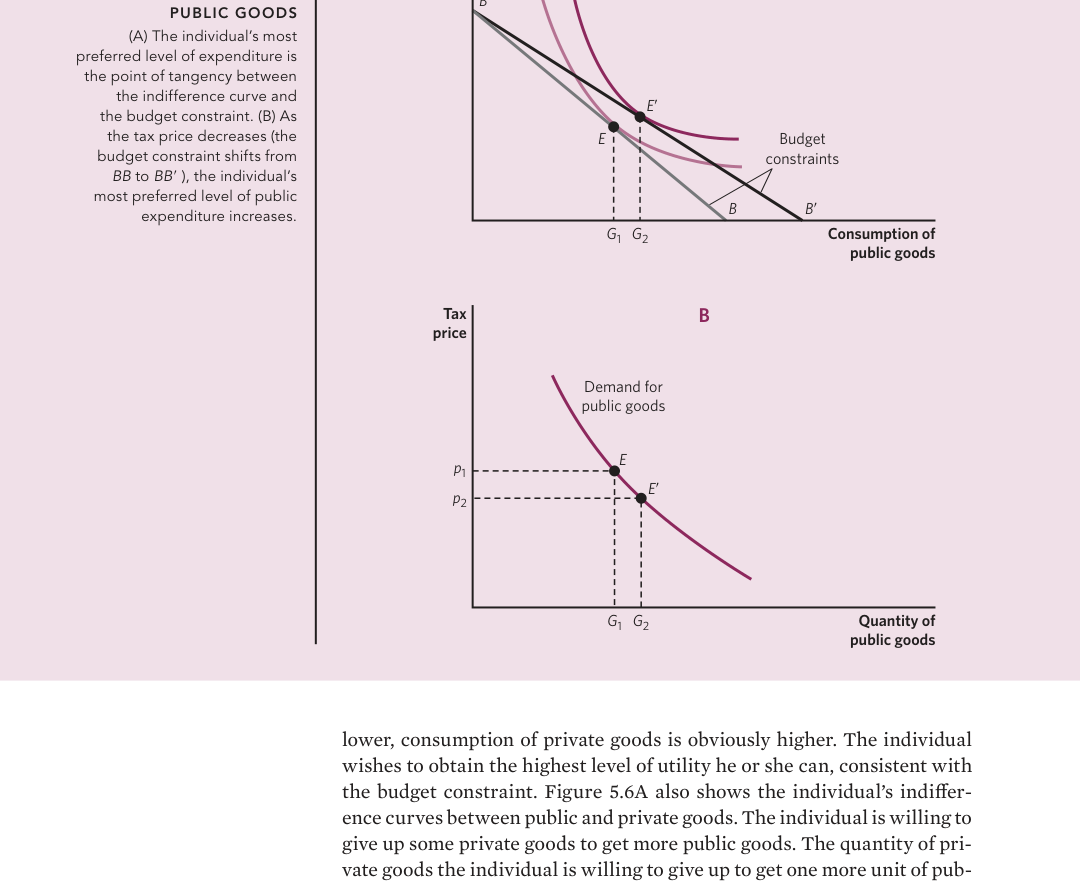
Conceptually, each individual has a preference for the quantity of public goods. Model:
- The individual has a fixed budget split between private consumption and the public good.
- The individual bears a tax price — the share of public spending they pay as taxes.
- As the tax price falls, the individual wants more of the public good.
9 · Collective Demand: Vertical Summation
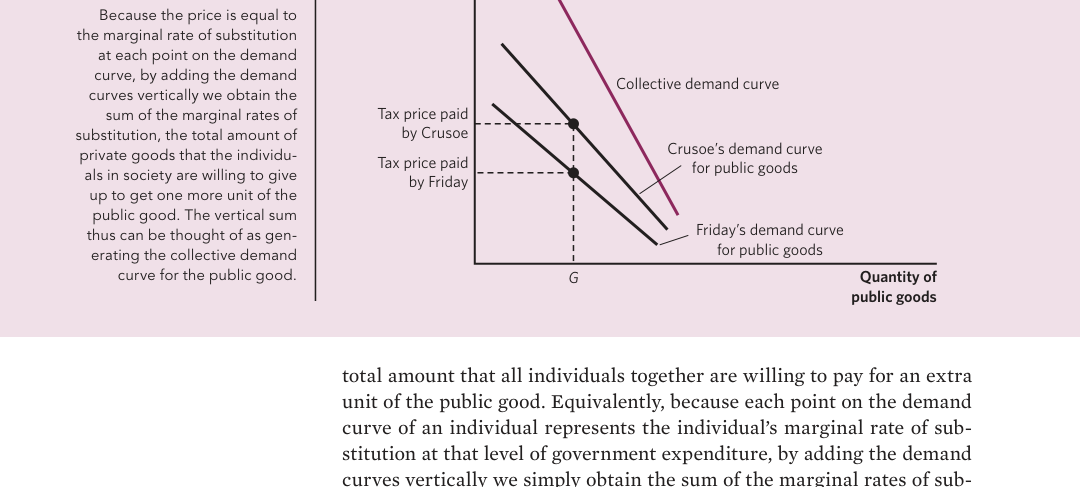
Here comes the key difference from private goods:
- For private goods: market demand arises through horizontal summation (at a given price, everyone consumes their own quantity).
- For public goods: collective demand arises through vertical summation (at a given quantity, everyone pays their own tax price).
10 · Efficient Provision — Samuelson Condition
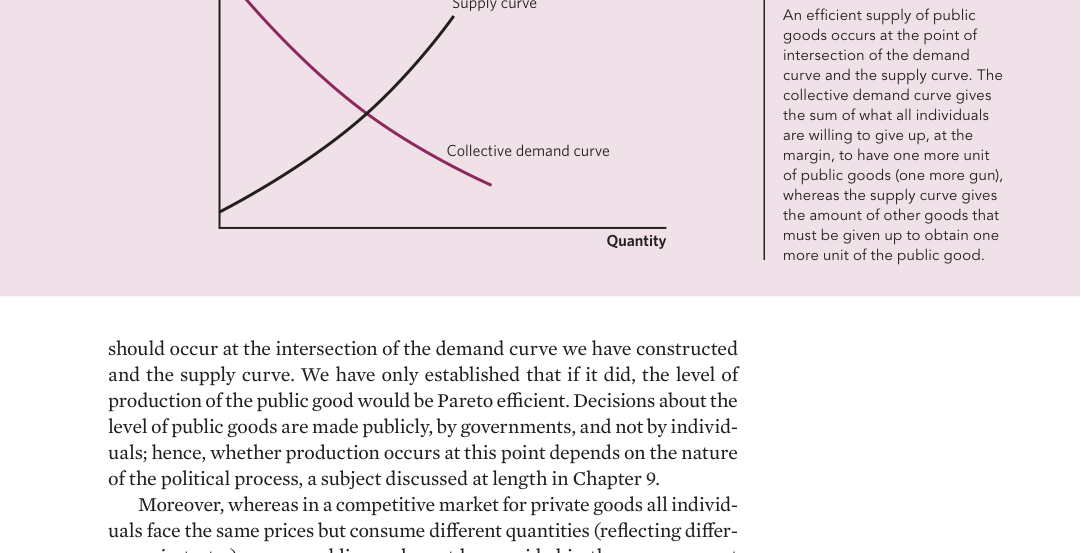
Pareto efficiency for public goods (Samuelson 1954):
Intuition: for private goods, MRS = MRT holds for each consumer. For public goods, everyone benefits simultaneously from an additional unit — hence the sum.
11 · Distribution Affects the Efficient Quantity
An important point: the efficient quantity of public goods depends on the income distribution. If income becomes more unequal, this affects the collective demand curve — and hence the optimal provision.
Unlike with private goods (where efficiency and distribution are separable, second welfare theorem), here efficiency and distribution are inseparably entangled.
12 · Distortionary Taxes and the Efficient Quantity
In practice, public goods are financed through distortionary taxes (income tax, VAT), not through ideal lump-sum transfers. Every tax has a deadweight loss.
Consequence: the actual efficient quantity of public goods is lower than the one in the ideal Samuelson model, because each additional unit means more tax burden (with DWL).